

EU showcases its quantum technology talent at MWC Barcelona 2026
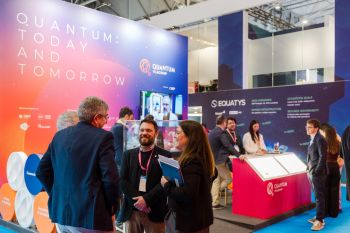
Europe’s flourishing quantum sector was on full display at MWC Barcelona 2026, one of the world’s largest and most influential technology events.
From quantum communication to cutting-edge computing infrastructure, companies supported by European initiatives showcased state-of-the-art technologies — some of which are already being deployed — at a time when the EU is aiming to make the continent a global leader in quantum by 2030.
During a dedicated roundtable session on Tuesday, March 3, organised by the Quantum Flagship — a 10-year initiative funded by the European Commission to accelerate the development of quantum technologies and their transition to the market — two experts with ties to EU projects discussed pioneering work in the field.
One was Vanesa Díaz, a member of the Flagship’s Quantum Secure Networks Partnership (QSNP) consortium as CEO of her company, LuxQuanta. The consortium, which counts dozens of leading public and private entities as partners, is focused on creating a sustainable European ecosystem in quantum cryptography and communication. Díaz discussed a technology known as quantum key distribution (QKD), which is designed to protect against today’s most advanced cyber threats, as well as the potential risks that quantum computing could pose to traditional encryption methods.
“It’s the level of security that we need to withstand the attack of quantum computers,” Díaz said at the roundtable.
The roundtable also featured Hugues de Riedmatten, a member of both the QSNP and another Flagship consortium called the Quantum Internet Alliance (QIA) in his role as a group leader in quantum optics at the Institute of Photonic Sciences (ICFO) in Catalonia. QIA is currently attempting to build the world’s first complete quantum internet prototype network that will leverage the phenomenon of quantum entanglement.

Entanglement is a very peculiar property of quantum physics where there is strong correlation between particles even though they may be very far apart. “Distributing entanglement" over a large scale is a key prerequisite of the “quantum internet,” according to the researcher. A quantum internet is a network that connects quantum devices, enabling ultra-secure communications and new types of real-world applications that are not achievable with the classical internet.
Showcasing European quantum innovation
Beyond the roundtable, emerging company Arq founded by Samuele Grandi — and born in large part thanks to QIA, a Quantum Flagship initiative — is looking to play an important role in the push towards a quantum internet. Arq is developing hardware for a future quantum internet in the form of quantum repeater nodes. The aim of this technology is to enable the deployment of quantum networks on a large scale. Without repeaters, the distribution of entanglement through optical fibres will be limited to short distances due to attenuation and noise.
“It's a great time to be in quantum communication in Europe,” Grandi said. “The goal the Commission gave us is to have a European quantum internet by the late 2030s. So now Europe is really pushing hard on this kind of technology.”
Elsewhere, Barcelona-based firm Qilimanjaro — which designs, builds and operates quantum computers based on its unique qubit technology — have been making significant progress.
Qilimanjaro said it achieved a world-first this year by completing the installation of a “multimodal quantum data centre” integrated into a high-performance classical computer system — and under the same software stack — at the Barcelona Supercomputing Center. The centre’s supercomputer was already the most powerful in Spain, and one of the most advanced in the world. But Qilimanjaro’s “multimodal approach” means the installation now combines both digital and analog quantum computing technologies — built fully with European technology — integrated into the classical computing infrastructure.
“This achievement represents a significant step for the European ecosystem. It strengthens technological sovereignty, demonstrates industrial integration of quantum systems, and reinforces Europe’s capacity to develop and deploy strategic infrastructure at scale,” said Qiliminajaro spokesperson, Eva Martin Fierro. “We believe this milestone positions Europe more firmly in the global quantum landscape and accelerates the transition from research to operational infrastructure.”
This new hybrid of analogue and digital quantum technologies, in combination with classical computing, will enable users of the facility — which include companies, public institutions and research centres — to select the most appropriate hardware for their particular goals.
“We strongly believe that the future of quantum computing will not rely on a single technology, but on multiple complementary approaches,” said Qilimanjaro solutions architect, Elisabeth Ortega.
Being “under the same software stack” indicates that the quantum computers in the installation use the same software libraries developed by Qilimanjaro. This software is designed specifically for the hardware in the quantum computers in order to avoid integration issues.
As well as developing on-premise systems for supercomputing centres and research institutions, Qilimanjaro is rolling out a remote-access service to its multimodal data centres, all part of its attempts to broaden access to quantum computing.
"Qilimanjaro's mission is to democratize access to quantum technologies,” Ortega said.
Going back to LuxQuanta, the company — a spin-off of ICFO — has commercialised systems designed for deployment in existing telecoms infrastructure that implement a form of QKD. This protocol leverages the principles of quantum mechanics to generate and distribute encryption keys, which are transmitted as quantum states over optical fibres. Any attempt to intrude on the data transmission alters the quantum state and is immediately detected by the system. In such cases, the old keys are destroyed and new ones are generated.
We as members of the QSNP “are very lucky to be Europe‑based because we have a huge support from the European Commission, which knows that this type of technology, quantum cryptography, is what we need in order to protect our networks,” Díaz said.
Another exhibitor at MWC is Quside, another QSNP member and European leader in quantum random number generation, processing and verification — technologies that have important applications in cybersecurity. The company’s solutions are already being deployed in various sectors including telecoms, government and critical infrastructure.
“Our end game is to be able to deploy this technology for anyone, everywhere. That means also consumer devices and phones,” said Carlos Abellán, co‑founder and CEO of Quside.
Together, these companies illustrate the diversity and growing maturity of Europe’s quantum ecosystem.